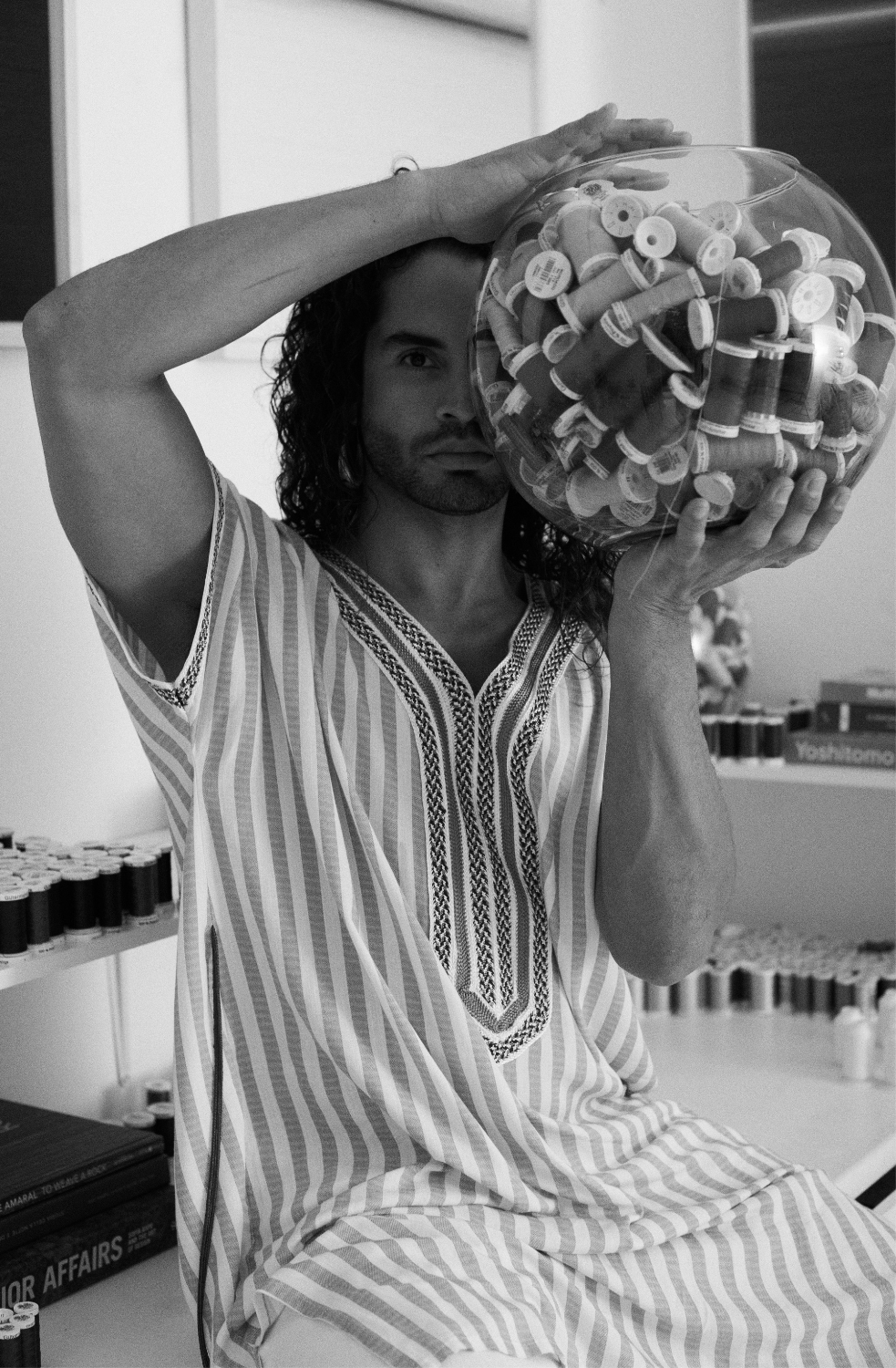
BIO
Critics have recognized Damián Suárez (Venezuelan–Mexican) for his unmistakable visual language and a technique that resists classification within any artistic framework. Through his work, he articulates a discourse that transcends generations and geographies, rooted in his intimate relationship with nature and the knowledge passed down in the mountains of the Altos Mirandinos, where he grew up in a rural settlement
Working entirely by hand, Suárez develops geometric compositions that merge textile, painting, and sculpture through a meticulous process of hand-pressed thread on wood, executed with a recognizably personal technique. This artisanal construction method defines his visual language and connects material precision with ancestral knowledge.
The artist intertwines his intuitive relationship with materials with the rigorous precision of optical and kinetic art that flourished in Venezuela during the oil-boom decades. The result is a body of work in which the textile medium—stripped of its utilitarian function and endowed with symbolic meaning—assumes systematic and ordered forms without losing its tactile, ancestral nature. In his hands, thread turns into memory and wood into territory: sites where stories of displacement and resistance have been inscribed throughout history.
Suárez conceives anachronism as a critical strategy, confronting the industrial and digital precision of contemporary geometric art with the organic and corporeal rhythm of manual craftsmanship. He places weaving—with its knots and interlacings that remain autonomous even when transformed into complex compositions—at the center of his discourse, destabilizing hierarchies between art and craft and turning textiles into instruments of political action.
By borrowing optical-kinetic grids and visual systems associated with the period of opulence and returning them to an ancestral realm, he turns his gaze toward Indigenous peoples such as the Ye’kwana, who, since ancient times, have developed a high degree of technical and aesthetic sophistication to express their worldview through patterns legible within the language of Op Art.
Within a generation shaped by institutional decay, wars, and displacement—where the search for identity and belonging grows increasingly urgent—Suárez’s work decolonizes itself, repositioning the value of the human gesture in the face of digital acceleration and reclaiming craft traditions as acts of memory and resistance.